Understanding the IPMAT 2028 total marks is an important part of exam preparation. While most students focus on completing the syllabus and solving mock tests, many overlook the significance of the marking scheme, marks distribution, and score calculation process. Knowing how the exam is scored helps candidates set realistic targets, develop effective test-taking strategies, and evaluate their performance accurately after the exam.
In this guide, we will discuss the expected IPMAT 2028 total marks, IPMAT marks distribution, IPMAT section-wise weightage, marking scheme, score calculation process, and the role of sectional scores in the selection process.
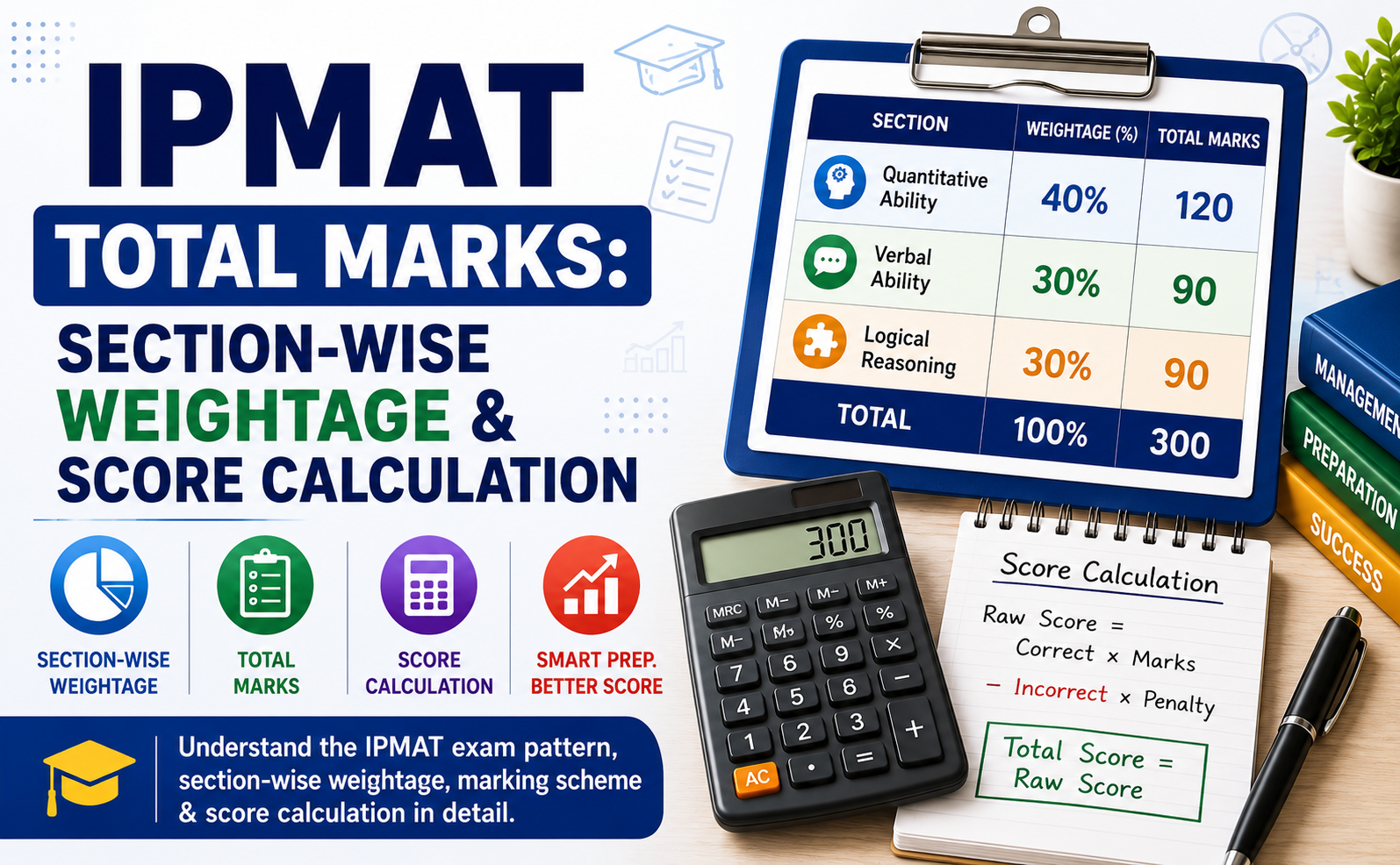
What Are the Total Marks in IPMAT 2028?
Based on the exam pattern followed in recent years, the IPMAT 2028 total marks are expected to be 360.
The exam is likely to consist of three sections:
- Quantitative Ability (Multiple Choice Questions)
- Quantitative Ability (Short Answer Questions)
- Verbal Ability (Multiple Choice Questions)
Each question carries four marks. However, the negative marking policy differs across sections, making it important for candidates to understand how scores are calculated.
The total score a candidate obtains out of 360 marks becomes one of the key factors considered during the shortlisting process for the next admission stages.
IPMAT 2028 Exam Structure at a Glance
The following table provides an overview of the expected exam pattern:
| Section | Number of Questions | Marks per Question | Maximum Marks |
| Quantitative Ability (MCQ) | 30 | 4 | 120 |
| Quantitative Ability (Short Answer) | 15 | 4 | 60 |
| Verbal Ability (MCQ) | 45 | 4 | 180 |
| Total | 90 | 4 | 360 |
As shown above, the exam consists of 90 questions carrying a total of 360 marks.
IPMAT Marks Distribution
Understanding the IPMAT marks distribution helps candidates identify where most marks are available and where they should focus their efforts.
The Quantitative Ability section is divided into two parts:
Quantitative Ability (MCQ)
This section contains 30 questions.
- Marks per question: 4
- Maximum marks: 120
Since negative marking applies, accuracy is important in this section.
Quantitative Ability (Short Answer)
This section contains 15 questions.
- Marks per question: 4
- Maximum marks: 60
One significant advantage of this section is that there is generally no negative marking. This means students can attempt all questions without the risk of losing marks for incorrect responses.
Verbal Ability
This section contains 45 questions.
- Marks per question: 4
- Maximum marks: 180
This is the largest section in the exam and contributes half of the total score.
The distribution clearly shows that both quantitative ability and verbal ability play equally important roles in the overall result.
IPMAT Section Wise Weightage
The IPMAT section-wise weightage determines how much each section contributes to the final score.
| Section | Maximum Marks | Weightage |
| Quantitative Ability (MCQ) | 120 | 33.33% |
| Quantitative Ability (Short Answer) | 60 | 16.67% |
| Verbal Ability | 180 | 50.00% |
| Total | 360 | 100% |
Key Observations
- Verbal ability carries the highest weightage.
- Quantitative ability collectively contributes 50% of the total score.
- Performance in both areas is necessary for a balanced score.
- Strong verbal skills can significantly improve overall performance.
- Quantitative sections remain crucial because sectional cutoffs may apply.
Candidates should avoid focusing exclusively on one section. A balanced preparation strategy usually produces better results than specializing in only quantitative ability or verbal ability.
IPMAT Marking Scheme 2028
The IPMAT marking scheme is designed to reward accuracy while discouraging random guessing in MCQ sections.
The expected marking scheme is shown below:
| Response Type | Marks Awarded |
| Correct Answer | +4 |
| Incorrect MCQ Answer | -1 |
| Unattempted Question | 0 |
| Incorrect Short Answer | 0 |
Positive Marking
Every correct answer earns four marks.
For example:
- 10 correct answers = 40 marks
- 20 correct answers = 80 marks
- 50 correct answers = 200 marks
Negative Marking
Negative marking generally applies only to MCQ sections.
For every incorrect MCQ response:
- One mark is deducted.
For example:
- 10 wrong answers = -10 marks
- 20 wrong answers = -20 marks
This deduction can significantly affect the final score.
No Negative Marking in Short-Answer Questions
The Quantitative Ability Short Answer section generally does not have negative marking.
This allows candidates to:
- Attempt all questions.
- Take calculated risks.
- Improve their overall score without fear of penalties.
Because of this feature, the Short Answer section often becomes an important scoring opportunity.
How Is IPMAT Score Calculation Done?
Understanding IPMAT score calculation helps candidates estimate their scores immediately after the exam.
The basic formula is:
Final Score = Total Positive Marks − Total Negative Marks
For MCQ sections:
Score = (Correct Answers × 4) − (Wrong Answers × 1)
For short-answer questions:
Score = Correct Answers × 4
Since there is no negative marking in the Short Answer section, incorrect responses do not reduce the score.
IPMAT Score Calculation Example
Let us understand the process through an example.
Quantitative Ability (MCQ)
Suppose a candidate attempts 28 questions.
Results:
- Correct answers: 18
- Incorrect answers: 10
Score:
(18 × 4) − (10 × 1)
72 − 10
= 62 marks
Quantitative Ability (Short Answer)
Results:
- Correct answers: 12
- Incorrect answers: 3
Score:
12 × 4
= 48 marks
Verbal Ability
Results:
- Correct answers: 34
- Incorrect answers: 8
- Unattempted: 3
Score:
(34 × 4) − (8 × 1)
136 − 8
= 128 marks
Final Score
QA (MCQ) = 62
QA (SA) = 48
VA = 128
Total Score:
62 + 48 + 128 = 238 marks
The candidate’s final IPMAT total score would be 238 out of 360.
Why Understanding IPMAT Total Score Matters
Many students focus only on solving questions without understanding how the score is calculated.
However, knowing the IPMAT total score structure helps in several ways.
Better Exam Strategy
Students can identify which sections offer the highest scoring opportunities.
Improved Time Management
Understanding weightage allows candidates to allocate time more effectively during the exam.
Reduced Negative Marking
Candidates become more cautious while attempting uncertain MCQ questions.
Realistic Target Setting
Students can set section-wise score goals rather than relying on overall estimates.
Performance Analysis
Mock test scores become more meaningful when candidates understand how the actual exam score is calculated.
Which Section Carries the Highest Weightage?
The Verbal Ability section carries the highest weightage.
With 45 questions and 180 marks, it contributes 50% of the overall score.
This means:
- Strong reading skills can improve performance significantly.
- Vocabulary preparation remains important.
- Reading comprehension practice should be consistent.
- Grammar and language usage concepts should not be ignored.
Students who perform well in verbal ability often gain a significant advantage in the final score.
What Is Considered a Good Score in IPMAT?
A good score depends on factors such as the following:
- Difficulty level of the paper
- Number of candidates appearing
- Category-wise cutoffs
- Admission policies of participating institutes
However, based on previous trends:
| Score Range | Performance Level |
| Below 150 | Average |
| 150–200 | Competitive |
| 200–240 | Good |
| 240–280 | Very Good |
| Above 280 | Excellent |
Candidates aiming for top IIMs should generally target a score above 240 while also ensuring that sectional cutoffs are cleared.
How Do Sectional Scores Affect Selection?
Many students assume that only the overall score matters.
In reality, sectional performance can be equally important.
Several institutes use sectional cutoffs to shortlist candidates.
For example:
A candidate may score well overall but fail to meet the required score in one section.
In such situations:
- The candidate may not receive a shortlist.
- Strong performance in one section may not compensate for poor performance in another.
Therefore, maintaining balance across all sections is essential.
What Score Is Considered Safe for Top IIMs?
There is no officially fixed safe score because cutoffs change every year.
However, candidates aiming for leading IPM programs often target the following:
- 220+ for a competitive profile
- 240+ for strong shortlisting chances
- 260+ for a highly competitive position
These figures should be viewed as general benchmarks rather than guaranteed cutoffs.
Common Mistakes Students Make While Calculating Scores
Ignoring Negative Marking
Many students calculate only positive marks and forget to deduct penalties.
Overestimating Accuracy
Students often assume more answers are correct than they actually are.
Not Using the Short Answer Section Effectively
Since there is no negative marking, leaving easy questions unattempted can reduce the final score.
Focusing Only on Overall Marks
Sectional scores are often equally important.
Excessive Guessing
Random guessing in MCQs may lead to unnecessary negative marks.
Avoiding these mistakes can improve both preparation and exam performance.
Tips to Maximize Your IPMAT Score
Focus on Accuracy
Reducing incorrect answers is often more beneficial than attempting additional doubtful questions.
Strengthen Verbal Ability
Since this section carries the highest weightage, consistent reading practice can significantly boost scores.
Utilize the Short Answer Section
Attempt all reasonable questions because there is no negative marking.
Analyze Mock Tests
Review mistakes and identify patterns that lead to negative marking.
Maintain Sectional Balance
Prepare all sections thoroughly to avoid missing sectional cutoffs.
Conclusion
Understanding the IPMAT 2028 total marks, marking scheme, score calculation process, and section-wise weightage is an important part of effective exam preparation. The exam is expected to carry 360 total marks, divided among Quantitative Ability (MCQ), Quantitative Ability (Short Answer), and Verbal Ability sections. While verbal ability contributes the highest weightage, quantitative ability remains equally important due to sectional cutoffs and its combined contribution to the final score.
Students who understand the IPMAT marks distribution, minimize negative marking, and maintain strong performance across all sections are generally better positioned to achieve competitive scores and improve their chances of admission to top IPM programs.
FAQs
1. What are the total marks in IPMAT 2028?
The expected IPMAT 2028 total marks are 360, distributed across Quantitative Ability (MCQ), Quantitative Ability (Short Answer), and Verbal Ability sections.
2. How are marks distributed across sections?
The distribution is:
- QA (MCQ): 120 marks
- QA (Short Answer): 60 marks
- Verbal Ability: 180 marks
- Total: 360 marks
3. What is the marking scheme for IPMAT?
Each correct answer carries 4 marks. Incorrect MCQ answers generally attract a penalty of 1 mark, while unattempted questions receive zero marks.
4. Is there negative marking in IPMAT?
Yes. Negative marking applies to MCQ sections. The Quantitative Ability Short Answer section generally has no negative marking.
5. How is the final score calculated?
The final score is calculated by adding marks earned from correct answers and subtracting penalties for incorrect MCQ responses.
6. Which section carries the highest weightage?
Verbal ability carries the highest weightage, contributing 180 marks or 50% of the total score.
7. What is considered a good score in IPMAT?
A score above 200 is generally considered good, while scores above 240 are often viewed as highly competitive.
8. How do sectional scores affect selection?
Many institutes use sectional cutoffs during the shortlisting process. Candidates must often perform well in each section, not just overall.
9. What score is safe for top IIMs?
Although cutoffs vary yearly, a score of 240 or above is generally considered a strong target for top IPM programs.
10. Does the scoring system differ between Indore and Rohtak?
Yes. IPMAT Indore and IPMAT Rohtak follows different exam patterns and section structures, which can result in differences in marking schemes and score calculation methods.