Among all sections of the MBA CET exam, Verbal Ability is often considered one of the most scoring areas for well-prepared candidates. Unlike Quantitative Aptitude or Logical Reasoning, where complex calculations and lengthy problem-solving may be required, Verbal Ability rewards consistent reading habits, strong language fundamentals, and regular practice.
For many aspirants, this section can become a significant percentile booster. At the same time, students with weak English fundamentals often struggle to convert easy questions into marks because of limited vocabulary, poor grammar understanding, or insufficient reading practice.
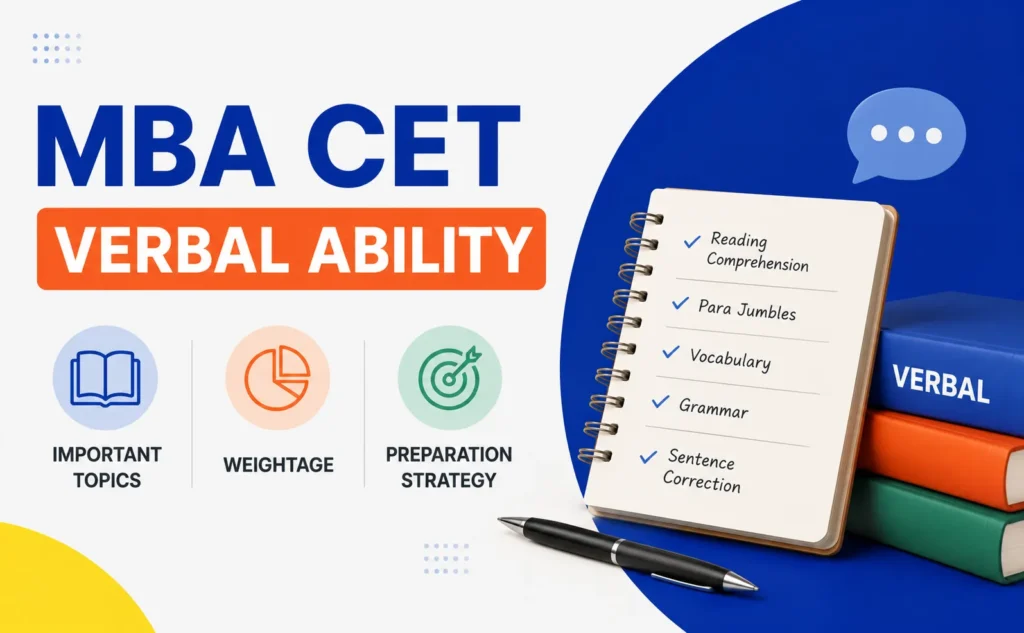
Understanding the important MBA CET Verbal Ability 2027 topics, expected weightage, preparation methods, and revision techniques can help candidates improve both speed and accuracy.
This guide covers the most important MBA CET Verbal Ability topics, expected question distribution, recommended books, preparation strategies, and practical tips for maximizing scores.
MBA CET Verbal Ability 2027: Section Overview
The Verbal Ability and Reading Comprehension section contributes significantly to the overall MBA CET score.
Section Highlights
| Component | Approximate Questions |
| Verbal Ability | 30–35 |
| Reading Comprehension | 15–20 |
| Total | 50 |
Key Facts
- Total Questions: 50
- Total Marks: 50
- No Negative Marking
- Moderate Difficulty Level
- Strong Scoring Potential
Students should understand the complete MBA CET exam pattern before beginning section-wise preparation.
Important Verbal Ability Topics for MBA CET 2027
While the exact paper varies every year, certain topics consistently appear in the exam.
Vocabulary
Questions may include:
- Synonyms
- Antonyms
- Word Usage
- Context-Based Vocabulary
Grammar
Important areas include:
- Sentence Correction
- Error Detection
- Subject-Verb Agreement
- Tenses
- Articles
- Prepositions
Para Jumbles
Students arrange sentences into a logical sequence.
Fill in the Blanks
These questions test vocabulary and contextual understanding.
Sentence Completion
Candidates identify the most suitable phrase or sentence.
Reading Comprehension
Passages are followed by inference-based and fact-based questions.
Critical Reasoning
Some papers include logic-based language questions that test analytical reading ability.
Which Topics Carry the Highest Weightage?
Certain areas contribute more consistently to the Verbal Ability section.
High-Weightage Topics
Reading Comprehension
Generally contributes a substantial share of the section.
Vocabulary-Based Questions
Frequently tested across different formats.
Grammar & Sentence Correction
A regular feature in MBA CET papers.
Para Jumbles
Often appear every year in some form.
Medium-Weightage Topics
- Fill in the Blanks
- Sentence Completion
- Critical Reasoning
Students should prioritize high-frequency topics before moving to less common question types.
How Should Beginners Prepare Verbal Ability?
Many students begin preparation believing that Verbal Ability can be improved overnight.
In reality, improvement comes through consistent exposure to language.
Step 1: Build Reading Habits
Read daily:
- Newspapers
- Editorials
- Business articles
- Magazines
Step 2: Strengthen Vocabulary
Learn new words regularly and revise them frequently.
Step 3: Practice Grammar
Focus on fundamental grammar concepts before attempting advanced questions.
Step 4: Solve Topic-Wise Questions
Build familiarity with individual question types.
Step 5: Attempt Sectional Tests
Measure improvement and identify weak areas.
Students following a structured MBA CET study plan generally improve Verbal Ability much faster than those practicing randomly.
Best Books for MBA CET Verbal Ability Preparation
Choosing the right study material can significantly improve preparation efficiency.
Recommended Books
Word Power Made Easy – Norman Lewis
Excellent for vocabulary building.
High School English Grammar & Composition – Wren & Martin
Strong resource for grammar fundamentals.
Objective General English – S.P. Bakshi
Useful for practice questions.
How to Prepare for Verbal Ability and Reading Comprehension for CAT – Arun Sharma & Meenakshi Upadhyay
Helpful for developing comprehension and verbal reasoning skills.
Students looking for comprehensive preparation resources should also explore the best books for MBA CET 2027 preparation before finalizing study material.
How Can Vocabulary Be Improved?
Vocabulary development is a gradual process.
Effective Techniques
Daily Reading
Read quality content every day.
Vocabulary Notebook
Maintain a dedicated word journal.
Context-Based Learning
Learn words within sentences rather than memorizing definitions.
Flashcards
Useful for regular revision.
Root Word Method
Understanding roots improves retention and comprehension.
Consistent vocabulary practice produces significant improvement over time.
How Important is Reading Comprehension?
Reading Comprehension often plays a major role in the Verbal Ability section.
Benefits of Strong RC Skills
- Improves accuracy
- Enhances reading speed
- Strengthens vocabulary
- Helps with inference questions
- Improves overall language ability
Many high-percentile candidates spend substantial preparation time improving comprehension rather than focusing exclusively on vocabulary.
Common Mistakes Students Should Avoid
Ignoring Reading Practice
Vocabulary alone cannot compensate for weak comprehension skills.
Memorizing Without Context
Words learned without application are quickly forgotten.
Neglecting Grammar
Grammar-based questions continue to appear regularly.
Practicing Too Few Questions
Insufficient exposure limits familiarity with question patterns.
Avoiding Difficult Passages
Challenging reading material improves comprehension ability over time.
Students solving most repeated MBA CET questions often identify common verbal patterns and improve efficiency.
How Many Questions Are Asked from Verbal Ability?
The Verbal Ability and Reading Comprehension section typically contains:
Approximately 50 Questions
These questions are distributed across:
- Reading Comprehension
- Grammar
- Vocabulary
- Para Jumbles
- Sentence Completion
- Fill in the Blanks
The exact distribution may vary from year to year.
Best Revision Strategy for Verbal Ability
Revision should be systematic rather than random.
Weekly Revision Plan
Vocabulary Revision
Review previously learned words.
Grammar Revision
Practice grammar concepts regularly.
Reading Practice
Continue daily reading habits.
Error Analysis
Review mistakes from sectional tests.
Mock-Based Revision
Focus on recurring weaknesses identified through tests.
Students preparing close to the examination can combine this approach with an effective MBA CET last week revision strategy to maximize performance.
How Can Students Improve Accuracy in This Section?
Accuracy is often the difference between a good percentile and an exceptional percentile.
Read Carefully
Avoid rushing through passages and questions.
Eliminate Wrong Options
Use logical elimination whenever possible.
Focus on Context
Many vocabulary questions are context-driven.
Review Mistakes
Analyze every incorrect answer.
Take Sectional Tests
Frequent testing improves both confidence and precision.
A structured MBA CET mock test strategy can help students identify recurring mistakes and improve accuracy consistently.
How Tarkashastra Helps Students Improve Verbal Ability
Many students struggle with Verbal Ability because they lack a structured approach.
Concept Building
Students receive:
- Grammar sessions
- Vocabulary frameworks
- Reading strategies
Practice Ecosystem
Includes:
- Topic-wise tests
- Sectional tests
- Full-length mocks
Performance Analysis
Students receive:
- Accuracy tracking
- Weak-area identification
- Improvement recommendations
Personalized Mentorship
Support includes:
- Preparation planning
- Reading guidance
- Revision strategy
- Test-taking techniques
This structured framework helps students improve both confidence and performance in the Verbal Ability section.
Conclusion
The MBA CET Verbal Ability 2027 section offers a significant scoring opportunity for candidates willing to invest time in reading, vocabulary building, grammar improvement, and consistent practice. Since this section rewards accuracy and comprehension rather than memorization alone, students should focus on developing strong language fundamentals and maintaining regular reading habits.
A balanced preparation strategy that combines concept learning, sectional practice, mock tests, and revision can substantially improve performance. By mastering the most important MBA CET Verbal Ability topics, candidates can strengthen their overall score and improve their chances of securing admission to top MBA CET colleges.
FAQs
1. What are the important Verbal Ability topics for MBA CET 2027?
Key topics include Reading Comprehension, Vocabulary, Grammar, Para Jumbles, Sentence Completion, Fill in the Blanks, and Critical Reasoning.
2. Which topics carry the highest weightage?
Reading Comprehension, Vocabulary, Grammar, and Para Jumbles generally contribute the largest share of questions.
3. How should beginners prepare Verbal Ability?
Beginners should focus on reading habits, vocabulary building, grammar fundamentals, and gradual practice through sectional tests.
4. What are the best books for preparation?
Popular choices include Word Power Made Easy, Wren & Martin, Objective General English, and Arun Sharma’s Verbal Ability resources.
5. How can vocabulary be improved?
Regular reading, flashcards, vocabulary notebooks, and contextual learning methods help improve vocabulary over time.
6. How important is Reading Comprehension?
Reading Comprehension is one of the most important components of the section and often contributes significantly to the overall score.
7. What mistakes should students avoid?
Students should avoid neglecting reading practice, ignoring grammar, memorizing words without context, and skipping revision.
8. How many questions are asked from Verbal Ability?
The Verbal Ability and Reading Comprehension section typically contains around 50 questions.
9. What is the best revision strategy?
Regular vocabulary revision, grammar practice, reading exercises, error analysis, and mock-based revision create an effective revision framework.
10. How can students improve accuracy in this section?
Accuracy improves through consistent practice, careful reading, mistake analysis, elimination techniques, and regular sectional testing.