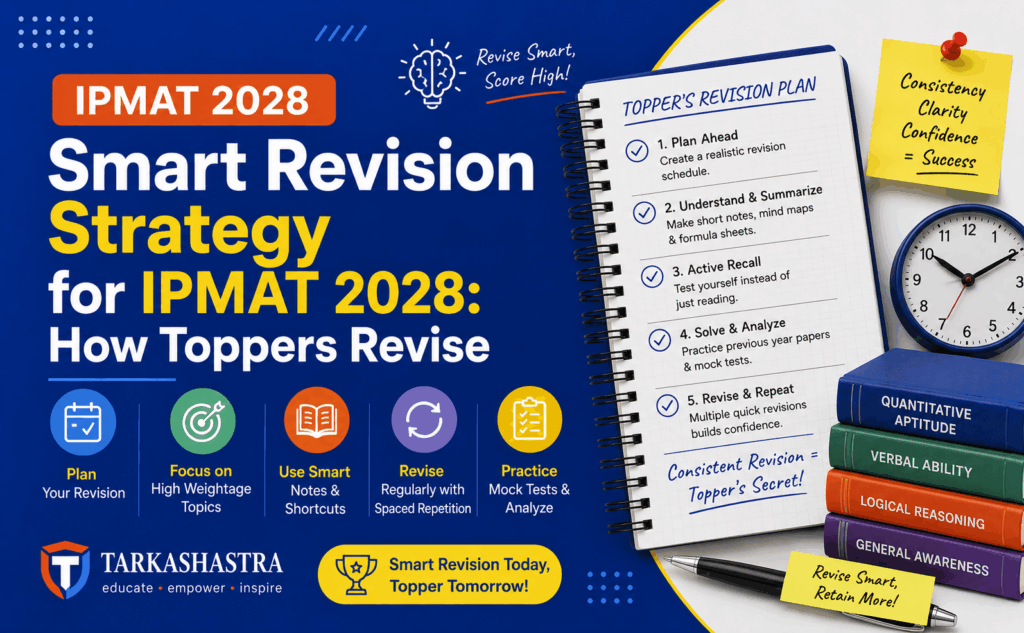
Introduction
Most IPMAT aspirants spend months learning concepts, solving questions, and taking mock tests. However, only a few students realize that success in IPMAT is not just about learning—it is about how effectively you revise.
In competitive exams like IPMAT, students often forget what they studied months earlier. Even strong concepts can weaken without regular revision. That is why toppers follow a structured IPMAT 2028 revision strategy that helps them retain concepts, improve accuracy, and perform consistently under pressure.
Revision is not a last-minute activity. It is a continuous process that runs alongside preparation and becomes the most important factor in the final months before the exam.
This guide explains how toppers revise, how many revision cycles are needed, how to structure a revision timetable, and how to build a powerful memory-based preparation system for IPMAT success.
Why Revision Is Critical for IPMAT 2028
IPMAT tests speed, accuracy, and consistency. Without revision, students often face the following:
- Forgetting formulas
- Confusion in problem-solving
- Slow calculation speed
- Poor accuracy in mocks
- Lack of confidence during exams
Revision ensures:
- Long-term memory retention
- Faster recall of formulas
- Better decision-making in mock tests
- Higher accuracy under time pressure
A strong IPMAT revision plan can improve performance more than learning new topics in the final months.
What Is a Smart IPMAT Revision Strategy?
A smart IPMAT 2028 revision strategy is not about revising everything repeatedly. It is about revising the right topics in the right way at the right time.
Toppers follow three principles:
1. Repetition with Purpose
They revise topics multiple times but with increasing speed and precision.
2. Active Recall
Instead of rereading, they test themselves repeatedly.
3. Error-Based Revision
They focus more on mistakes than perfect topics.
When Should Students Start Revising for IPMAT?
Revision should start much earlier than most students think.
Ideal Timeline
- From Day 1: Light revision of previous topics
- After Each Chapter: Immediate revision within 24–48 hours
- Monthly: Full revision of completed syllabus
- Final 3–4 months: Intensive revision cycles
- Final month: Complete revision focus only
Early revision prevents knowledge decay and improves retention.
How Many Revision Cycles Are Ideal?
A strong IPMAT revision schedule includes multiple cycles.
Recommended Revision Cycles:
First Cycle: Concept Revision
- Immediately after completing a topic
- Focus on understanding
Second Cycle: Practice Revision
- After completing a section
- Focus on solving questions again
Third Cycle: Mock-Based Revision
- After mock tests
- Focus on weak areas
Fourth Cycle: Final Revision
- Full syllabus revision before exam
Most toppers complete 3–4 revision cycles before IPMAT.
IPMAT Toppers Revision Strategy
Toppers do not revise randomly. They follow structured methods.
1. Short Notes System
They maintain:
- Formula sheets
- Vocabulary lists
- Shortcut techniques
- Error notebooks
These help in fast revision.
2. Daily Revision Habit
Even during preparation, toppers revise daily:
- 20–30-minute formulas
- 20 minutes of vocabulary
- 15 minutes of error review
This prevents forgetting.
3. Weekly Revision Cycle
Every week they:
- Revise one full topic
- Revisit old questions
- Analyze mock tests
How Toppers Revise Quantitative Aptitude
Quantitative aptitude is the most revision-intensive section.
Toppers Follow This Method:
Step 1: Formula Revision
They revise formulas daily before solving problems.
Step 2: Topic Revision
They revisit key chapters:
- Arithmetic
- Algebra
- Geometry
- Number System
- Modern Math
Step 3: Mixed Practice
They solve random questions from all topics.
Step 4: Timed Revision
They practice under time limits to improve speed.
Key Insight:
Toppers never rely on solving only new questions. They repeatedly solve old, incorrect, and mixed questions.
Best Way to Revise Verbal Ability
Verbal ability requires a different approach.
1. Reading Habit
Toppers read daily:
- Editorials
- Articles
- Business news
This improves comprehension naturally.
2. Vocabulary Revision
They revise:
- Word lists
- Synonyms/antonyms
- Context usage
Using spaced repetition improves memory.
3. Practice RC Passages
They regularly solve:
- Reading comprehension passages
- Inference questions
- Tone-based questions
4. Grammar Revision
Instead of learning new rules repeatedly, they revise:
- Common error patterns
- Sentence correction rules
- Practice mistakes
Should Students Make Short Revision Notes?
Yes, absolutely.
Short notes are the backbone of any strong IPMAT revision plan.
What to Include:
- Formulas
- Shortcut tricks
- Important vocabulary
- Common mistakes
- Difficult questions
Benefits:
- Quick revision before exams
- Better retention
- Faster recall during mocks
Toppers revise mostly through short notes in the final months.
How to Remember Formulas Effectively
Memory-based revision is essential for quantitative aptitude.
Effective Techniques:
1. Daily Revision
Revise formulas every day for 10–15 minutes.
2. Write and Recall
Write formulas without looking and check accuracy.
3. Application-Based Learning
Use formulas in problem-solving immediately.
4. Flashcards Method
Create quick revision cards for key formulas.
5. Weekly Revision Test
Test yourself on formulas every weekend.
How Mock Tests Should Be Used in Revision
Mock tests are not just practice—they are revision tools.
Correct Method:
Step 1: Take Mock Test
Simulate real exam conditions.
Step 2: Analyze Mistakes
Identify:
- Concept errors
- Time management issues
- Guessing errors
Step 3: Revise Weak Topics
Go back and revise related concepts immediately.
Step 4: Reattempt Questions
Solve incorrect questions again.
Toppers spend more time analyzing mocks than attempting them.
Which Topics Should Be Revised Most Frequently?
Some topics require repeated revision due to their importance.
Quantitative Aptitude:
- Arithmetic
- Algebra
- Percentages
- Geometry
- Probability
Verbal Ability:
- Reading Comprehension
- Vocabulary
- Sentence Correction
- Para Jumbles
Reasoning (if applicable):
- Puzzles
- Logical sequences
- Arrangements
Frequent revision ensures better accuracy.
Monthly Revision Plan
A structured IPMAT revision timetable should include:
Week 1:
Revise quantitative topics.
Week 2:
Revise Verbal Ability
Week 3:
Mock tests + analysis
Week 4:
Mixed revision + weak areas
This cycle should repeat monthly.
Last 3 Months Revision Strategy
The final months are critical.
Focus Areas:
- Full syllabus revision
- Daily formula revision
- Mock tests every week
- Error notebook revision
Avoid learning new concepts.
Last Month’s Revision Strategy
The last month’s revision IPMAT strategy is simple:
1. Only Revision
No new topics.
2. Mock Tests
2–3 full mocks per week.
3. Error Correction
Focus only on mistakes.
4. Speed Practice
Improve question selection and timing.
Final Week Strategy
The final week should be calm and focused.
Do:
- Revise formulas daily
- Go through vocabulary notes
- Review mock mistakes.
- Light practice
Avoid:
- Heavy new practice
- Stressful studying
- Overloading information
Common Mistakes in Revision Phase
1. Starting Revision Too Late
Revision must begin early.
2. Ignoring Mock Analysis
Mocks without analysis are useless.
3. Reading Instead of Practicing
Revision should be active, not passive.
4. Not Using Short Notes
Without notes, revision becomes slow.
5. Overloading New Material
The revision phase is not for learning new topics.
IPMAT Memory Tips for Better Retention
1. Spaced Repetition
Revise topics at increasing intervals.
2. Active Recall
Test yourself instead of reading.
3. Visualization
Use charts and diagrams for concepts.
4. Writing Practice
Writing improves memory retention.
5. Teaching Method
Explain concepts to yourself or others.
How to Build a Strong Revision System
A powerful IPMAT study strategy includes the following:
Daily:
- 30 minutes of revision
Weekly:
- Mock test + analysis
Monthly:
- Full syllabus revision
Quarterly:
- Full mock cycle + error correction
Consistency is the key.
Final Thoughts
A strong IPMAT 2028 revision strategy is what separates average students from toppers. While studying builds understanding, revision builds performance. Without revision, even well-prepared students struggle with accuracy and speed during the exam.
Toppers succeed because they revise continuously, analyze mistakes deeply, and focus on repetition rather than overloading themselves with new content. A structured IPMAT revision plan ensures that every concept is retained, every mistake is corrected, and every mock test improves performance.
If you want to crack IPMAT, remember this simple rule:
Study builds knowledge, but revision builds rank.
FAQs
1. When should students start revising for IPMAT?
Revision should start immediately after completing each topic and continue regularly throughout preparation, not just in the final months.
2. How many revision cycles are ideal before the exam?
Most toppers complete 3–4 revision cycles, including concept revision, practice revision, mock-based revision, and final revision.
3. How do IPMAT toppers revise quantitative aptitude?
They revise formulas daily, practice mixed questions, analyze mock tests, and repeatedly solve previously incorrect problems.
4. What is the best way to revise verbal ability?
The best method includes daily reading, vocabulary revision, RC practice, grammar error analysis, and spaced repetition techniques.
5. Should students make short revision notes?
Yes. Short notes for formulas, vocabulary, and shortcuts are essential for quick revision before the exam.
6. How can students remember formulas effectively?
Through daily revision, writing practice, flashcards, application-based learning, and regular testing.
7. How should mock tests be used during revision?
Mocks should be used for testing, followed by deep analysis and immediate revision of weak topics and mistakes.
8. Which topics should be revised most frequently?
Arithmetic, algebra, geometry, reading comprehension, vocabulary, and grammar should be revised regularly.
9. What should students avoid during the revision phase?
Students should avoid learning new topics, ignoring mock analysis, passive reading, and inconsistent revision.
10. What is the best revision strategy for the final week?
Focus only on formulas, vocabulary, mock mistakes, and light practice while avoiding stress and new learning.