Introduction
Every year, thousands of students appear for the Integrated Program in Management Aptitude Test (IPMAT) with the dream of securing admission to prestigious IIMs. While syllabus coverage and mock tests are essential, analyzing the IPMAT exam paper from previous years can provide valuable insights into the exam’s evolving nature.
An in-depth IPMAT paper analysis helps aspirants understand changing question patterns, recurring topics, section-wise difficulty, and overall exam trends. Such analysis enables students to prepare strategically rather than relying solely on theoretical study.
In this article, we examine the IPMAT difficulty level over the years, identify major IPMAT trends, and discuss what future aspirants can expect from upcoming exams.
Why Analyzing the IPMAT Exam Paper Is Important
Many students focus only on completing the syllabus. However, successful candidates spend considerable time studying previous papers and identifying patterns.
Benefits of paper analysis include:
- Understanding changing difficulty levels
- Identifying frequently tested topics
- Recognizing section-wise trends
- Improving preparation strategy
- Learning time-management techniques
- Setting realistic score targets
Past papers provide valuable clues about how the examination evolves over time.
Overview of the IPMAT Examination
Before analyzing trends, let’s understand the exam structure.
IPMAT Indore Pattern
| Section | Type of Questions |
| Quantitative Ability (MCQ) | Multiple Choice |
| Quantitative Ability (Short Answer) | Type-in-the-answer |
| Verbal Ability | Multiple Choice |
IPMAT Rohtak Pattern
| Section | Type of Questions |
| Quantitative Ability | MCQ |
| Logical Reasoning | MCQ |
| Verbal Ability | MCQ |
Although both exams aim to evaluate aptitude and analytical skills, their structures differ significantly.
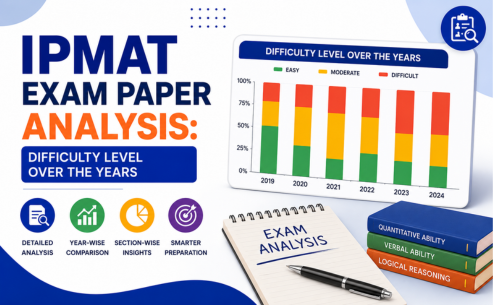
Evolution of IPMAT Difficulty Level Over the Years
The IPMAT difficulty level has not remained constant.
As competition has increased and applicant numbers have grown, the exam has become more refined and competitive.
Early Years
During the initial years:
- Questions were relatively direct.
- Quantitative ability was moderate.
- Verbal ability emphasized grammar and vocabulary.
- Students with strong fundamentals performed well.
Middle Phase
As awareness of IPMAT increased:
- Quant questions became conceptually demanding.
- Reading comprehension passages became longer.
- Greater emphasis was placed on application-based questions.
Recent Years
Recent papers indicate:
- Increased focus on problem-solving ability
- More balanced section-wise difficulty
- Reduced predictability in question distribution
- Greater importance of speed and accuracy
Overall, the exam now tests analytical thinking more rigorously than before.
How Has the Difficulty Level Changed Over the Years?
One of the most frequently asked questions concerns changes in exam difficulty.
Quantitative Ability
The quantitative section has shown the most noticeable increase in complexity.
Recent papers feature the following:
- Multi-concept questions
- Lengthy calculations
- Higher-level algebra
- Advanced arithmetic applications
Students often report that quantitative ability has become increasingly challenging.
Verbal Ability
The verbal section remains relatively stable but has evolved in certain areas.
Recent trends include:
- Longer reading comprehension passages
- Context-based vocabulary
- Logical sentence arrangement questions
- Critical reasoning elements
Overall Difficulty
| Period | Difficulty Level |
|---|---|
| Early Years | Moderate |
| Middle Years | Moderate to Difficult |
| Recent Years | Difficult |
The overall trend suggests a gradual increase in competitiveness.
Which Year Had the Toughest IPMAT Paper?
Based on student feedback and coaching institute analyses, certain years stand out for their difficulty.
Characteristics of the Toughest Papers
Typically, difficult papers include:
- Lengthy quantitative problems
- Unexpected question types
- Time-consuming calculations
- Tricky verbal reasoning questions
Many experts consider some of the recent post-pandemic editions among the toughest due to increased emphasis on analytical problem-solving.
However, difficulty remains subjective and depends on a student’s strengths and weaknesses.
Major IPMAT Trends Observed Over the Years
Several important IPMAT trends have emerged through continuous paper analysis.
Trend 1: Increasing Importance of Conceptual Clarity
Memorized formulas alone are no longer sufficient.
Students must understand concepts deeply.
Trend 2: Focus on Application-Based Questions
Questions increasingly test practical application rather than rote learning.
Trend 3: Higher Emphasis on Time Management
The ability to solve quickly has become as important as solving correctly.
Trend 4: Balanced Section Distribution
Exams now assess multiple skill areas more evenly.
Trend 5: Greater Variety in Question Framing
Question formats change frequently, making adaptability essential.
Section-Wise Difficulty Analysis
Quantitative Ability
Difficulty Level: High
Most aspirants consider this the toughest section.
Common topics include:
| Topic | Frequency |
|---|---|
| Arithmetic | Very High |
| Algebra | High |
| Number System | High |
| Geometry | Moderate |
| Modern Mathematics | Moderate |
Challenges include:
- Complex calculations
- Multiple concepts in one question
- Limited time
Verbal Ability
Difficulty Level: Moderate
Frequently tested areas include:
| Topic | Frequency |
|---|---|
| Reading Comprehension | Very High |
| Vocabulary | High |
| Grammar | High |
| Para Jumbles | Moderate |
| Sentence Correction | Moderate |
The verbal section often rewards consistent reading habits.
Logical Reasoning (Rohtak)
Difficulty Level: Moderate to Difficult
Common topics include:
- Puzzles
- Seating Arrangement
- Coding-Decoding
- Blood Relations
- Series
Performance largely depends on regular practice.
Which Section Is Usually the Most Difficult?
For most students, the answer is clear:
Quantitative Ability
Reasons include:
- Higher conceptual depth
- More calculations
- Greater time consumption
- Strong mathematical foundation required
Even high-performing candidates often find quant more challenging than verbal ability.
Students from non-mathematics backgrounds generally require additional preparation time for this section.
Topics That Appear Regularly in IPMAT Exam Papers
Despite changes in question style, several topics consistently appear.
Quantitative Ability
Arithmetic
Common subtopics:
- Percentages
- Profit and Loss
- Time and Work
- Ratio and Proportion
- Simple and Compound Interest
Algebra
Regularly tested areas include:
- Equations
- Inequalities
- Functions
Number System
Students frequently encounter the following:
- Divisibility
- Remainders
- Factors
Verbal Ability
Recurring topics include:
- Reading Comprehension
- Vocabulary
- Grammar
- Para Jumbles
These topics should remain preparation priorities.
Has the Exam Pattern Changed Significantly?
The core structure of the exam has remained relatively stable.
However, there have been notable refinements.
What Has Remained Consistent?
- Focus on aptitude
- Emphasis on analytical ability
- Verbal and quantitative assessment
What Has Changed?
- Question framing
- Difficulty level
- Section-wise weightage in some years
- Complexity of quantitative questions
Therefore, students should stay flexible rather than relying solely on older patterns.
How Can Paper Analysis Help Preparation?
A proper IPMAT paper analysis provides multiple preparation advantages.
Better Topic Prioritization
Students can focus on high-frequency topics.
Improved Time Allocation
Understanding section difficulty helps optimize study schedules.
Stronger Exam Strategy
Analysis helps determine:
- Which section to attempt first
- Which questions to skip
- How much time to spend per section
Enhanced Confidence
Familiarity with paper patterns reduces exam anxiety.
Lessons Students Can Learn from Past Papers
Past papers offer several valuable lessons.
Lesson 1: Fundamentals Matter
Every year, questions are built upon basic concepts.
Lesson 2: Speed Alone Is Not Enough
Accuracy remains equally important.
Lesson 3: Adaptability Is Essential
The exam frequently introduces new question variations.
Lesson 4: Reading Skills Matter
Strong comprehension abilities improve overall performance.
Lesson 5: Consistency Beats Last-Minute Preparation
Regular practice produces better results than cramming.
How Should Aspirants Adapt to Changing Trends?
The best approach is dynamic preparation.
Build Strong Concepts
Focus on understanding rather than memorization.
Solve previous years’ papers.
Analyze at least 10–15 papers.
Take Mock Tests Regularly
Mocks help simulate actual exam conditions.
Develop Section-Wise Strategies
Each section requires a different approach.
Review Mistakes Thoroughly
Learning from errors accelerates improvement.
Students who adapt quickly generally outperform those following rigid preparation methods.
Expected Difficulty Level for IPMAT 2028
While predicting exact difficulty is impossible, historical trends provide useful clues.
Likely Expectations
- Moderate to difficult overall paper
- Challenging quantitative section
- Concept-based verbal questions
- Greater emphasis on analytical reasoning
- Increased competition due to rising applicant numbers
What Students Should Prepare For
Aspirants targeting IPMAT 2028 should:
- Strengthen arithmetic and algebra
- Practice advanced reading comprehension
- Develop strong time-management skills
- Solve previous year papers extensively
Based on recent trends, the IPMAT difficulty level is unlikely to decrease significantly.
Conclusion
Analyzing the IPMAT exam paper over the years reveals clear patterns. The examination has gradually become more competitive, with increasing emphasis on conceptual understanding, analytical thinking, and efficient time management.
A thorough IPMAT paper analysis helps students identify recurring topics, understand changing question trends, and build effective preparation strategies. While the IPMAT difficulty level has increased over time, aspirants who consistently practice previous papers, take mock tests, and adapt to evolving IPMAT trends can significantly improve their chances of success.
Rather than fearing changing patterns, students should view them as opportunities to develop stronger problem-solving skills and gain a competitive edge.
FAQs
1. How has the difficulty level changed over the years?
The IPMAT exam has gradually become more challenging, especially in the quantitative ability section, with greater emphasis on conceptual application and analytical thinking.
2. Which year had the toughest IPMAT paper?
Several recent editions are considered among the toughest due to higher quantitative complexity and increased competition, though difficulty perceptions vary among students.
3. What are the major trends observed?
Major trends include increased conceptual depth, application-based questions, balanced section difficulty, and greater importance of time management.
4. Which section is usually the most difficult?
Quantitative ability is generally considered the toughest section because of its conceptual complexity and calculation-intensive questions.
5. How can paper analysis help preparation?
Paper analysis helps identify important topics, understand question patterns, improve time management, and create a focused preparation strategy.
6. What topics appear regularly?
Arithmetic, Algebra, Number System, Reading Comprehension, Vocabulary, and Grammar consistently appear in IPMAT papers.
7. Has the exam pattern changed significantly?
The core structure remains similar, but question framing, complexity, and emphasis on analytical thinking have evolved over time.
8. What lessons can students learn from past papers?
Students learn the importance of conceptual clarity, accuracy, adaptability, consistent practice, and effective time management.
9. How should aspirants adapt to changing trends?
Aspirants should focus on strong fundamentals, solve previous papers regularly, take mock tests, and continuously analyze their mistakes.
10. What is the expected difficulty level for 2028?
Based on recent trends, IPMAT 2028 is expected to be moderately difficult to difficult, with a strong focus on analytical reasoning and quantitative aptitude.