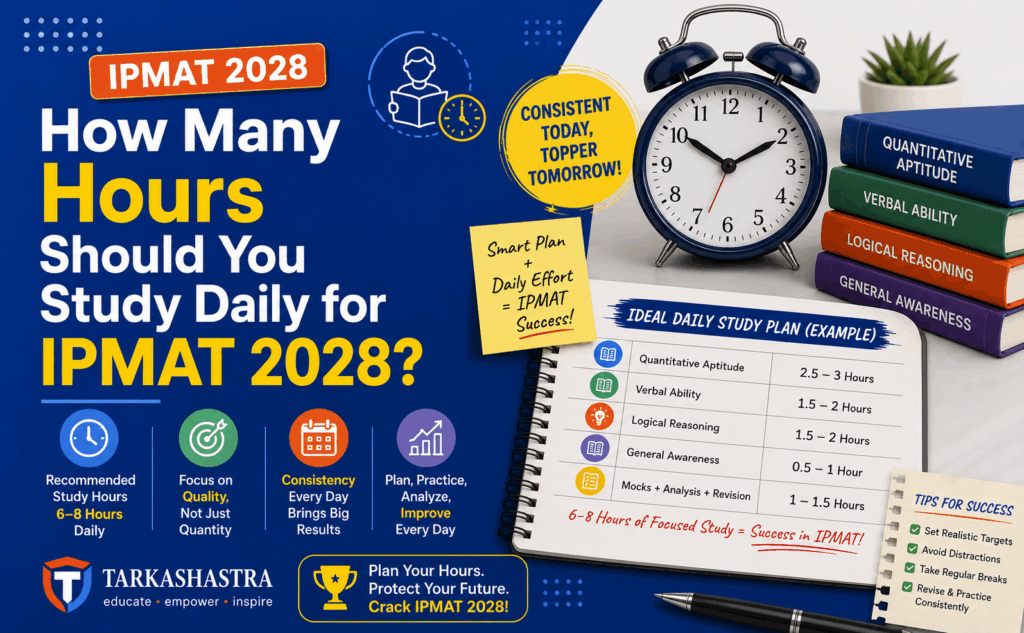
Introduction
When students begin preparing for the Integrated Programme in Management Aptitude Test (IPMAT), one question arises almost immediately: How many hours should one study for IPMAT 2028?
Some students believe they need to study 8–10 hours every day to succeed. Others assume that a few hours on weekends are enough. The reality lies somewhere in between.
Unlike board examinations that primarily test subject knowledge, IPMAT evaluates aptitude, reasoning ability, verbal skills, analytical thinking, and time management. Success depends on how well you use your study hours, not just on how many you put in.
A student studying three focused hours daily can often outperform another student spending seven distracted hours. Consistency, quality practice, revision, and mock test analysis matter far more than simply increasing study time.
This comprehensive guide explains the ideal daily study hours for IPMAT, how study requirements change during different stages of preparation, how toppers approach their preparation, and how students can create a sustainable routine that leads to success.
Is There an Ideal Number of Study Hours for IPMAT?
The short answer is no.
There is no universal rule that says the following:
- 2 hours guarantees success.
- 5 hours guarantees success.
- 8 hours guarantees success.
The required study time depends on several factors:
- Current academic level
- Mathematical foundation
- English proficiency
- Preparation stage
- School or college workload
- Target institute
- Existing aptitude skills
However, there are practical study-hour ranges that work effectively for most students.
Why Study Hours Alone Do Not Determine Success
Many students become obsessed with tracking study hours.
They ask:
- Should I study 6 hours?
- Should I study 8 hours?
- Should I study more than toppers?
The better question is
What did you accomplish during those hours?
Consider these two students:
Student A
- Studies 8 hours.
- Frequently checks social media.
- Rarely analyzes mistakes.
- Revises inconsistently.
Student B
- Studies 3 focused hours.
- Practice regularly.
- Revises weekly.
- Take mock tests seriously.
In most cases, Student B will perform better.
This highlights an important principle:
Quality always beats quantity.
Understanding the Different Stages of Preparation
The answer to how many hours should you study for IPMAT 2028 depends heavily on when you begin preparation.
Class 11 Student
Focus:
- Building foundations.
- Developing reading habits.
- Understanding aptitude concepts.
Class 12 Student
Focus:
- Balancing Boards and IPMAT.
- Completing the syllabus.
- Practicing regularly.
Drop-Year Aspirant
Focus:
- Intensive preparation.
- Mock tests.
- Revision.
- Weak-area improvement.
Each group requires a different study schedule.
Ideal Study Hours for Class 11 Students
Students beginning early often ask whether they need to study extensively.
The answer is no.
Recommended Daily Study Hours
Weekdays:
- 1.5–2 Hours
Weekends:
- 3–4 Hours
This time frame is sufficient because Class 11 students have nearly two years before the exam.
The objective should be:
- Building strong fundamentals.
- Improving vocabulary.
- Developing quantitative skills.
- Creating study habits.
There is no need for aggressive preparation at this stage.
Ideal Study Hours for Class 12 Students
Class 12 students face the challenge of balancing board examinations and entrance preparation.
Recommended Daily Study Hours
Regular Academic Months:
- 2–4 Hours Daily
Board Exam Season:
- 1–2 Hours IPMAT
- Remaining Time for Boards
After Board Exams:
- 6–8 Hours of Focused IPMAT Preparation
The emphasis should shift gradually throughout the year.
Ideal Study Hours for Gap-Year Students
Students taking a gap year can dedicate significantly more time.
Recommended Daily Study Hours
- 5–7 Productive Hours
This should include:
- Concept revision
- Practice questions
- Mock tests
- Mock analysis
- Reading comprehension
- Vocabulary development
Even for full-time aspirants, studying 12–14 hours daily is usually unnecessary and difficult to sustain.
Are 2–3 Hours Daily Enough for IPMAT?
One of the most frequently asked questions is whether 2–3 hours of daily preparation are enough for IPMAT.
The answer is:
Yes, if:
- You start early.
- You study consistently.
- You follow a structured plan.
- You revise regularly.
- You take mock tests seriously.
No, if:
- You begin very late.
- Your fundamentals are weak.
- You study irregularly.
- You waste time during study sessions.
For most Class 11 and Class 12 students, 2–3 focused hours daily are sufficient.
Understanding Quality Study
The concept of quality study is often misunderstood.
Quality study means:
Active Learning
Solving questions rather than merely reading solutions.
Focused Sessions
Studying without distractions.
Regular Revision
Revisiting concepts repeatedly.
Mistake Analysis
Learning from errors.
Consistent Practice
Developing familiarity with exam patterns.
A productive three-hour session can easily outperform six hours of passive studying.
How Should Daily Study Hours Be Divided?
A balanced IPMAT daily plan should allocate time across different sections.
For a 3-Hour Study Schedule
| Activity | Duration |
| Quantitative Aptitude | 90 Minutes |
| Verbal Ability | 45 Minutes |
| Reading Practice | 15 Minutes |
| Revision | 30 Minutes |
This structure ensures comprehensive preparation.
How Much Time Should Be Given to Quantitative Aptitude?
Quantitative ability generally requires the largest share of preparation time.
Recommended:
Beginners
60–90 Minutes Daily
Intermediate Students
90 Minutes Daily
Advanced Students
60 Minutes Practice + Mock Review
Topics include:
- Arithmetic
- Algebra
- Geometry
- Number System
- Modern Mathematics
Consistent daily exposure is critical.
How Much Time Should Be Given to Verbal Ability?
Many students underestimate verbal preparation.
Recommended:
Vocabulary
15–20 Minutes
Reading Comprehension
20–30 Minutes
Grammar
15–20 Minutes
Total:
45–60 Minutes Daily
Verbal skills improve gradually and require long-term effort.
The Importance of Daily Reading
One of the highest-return activities for IPMAT aspirants is reading.
Daily reading improves:
- Vocabulary
- Comprehension
- Speed
- Critical thinking
- Interview readiness
Students should spend at least:
20–30 Minutes Daily
reading:
- Newspapers
- Editorials
- Business articles
- Non-fiction books
This habit compounds over time.
How Many Hours Do IPMAT Toppers Study?
Students are often curious about IPMAT topper strategy.
The truth is that toppers rarely focus solely on study hours.
Instead, they focus on:
- Consistency
- Accuracy
- Mock analysis
- Revision
- Time management
Many successful candidates report studying:
During School
2–4 Focused Hours Daily
During Final Months
5–8 Focused Hours Daily
Their success comes from disciplined execution rather than extraordinary study durations.
Should You Study Every Day?
Consistency is one of the most important factors in IPMAT preparation.
However, studying every day does not mean:
- No breaks.
- No relaxation.
- No social life.
A sustainable approach includes:
Daily Learning
Small, consistent progress.
Weekly Breaks
Short periods of relaxation.
Balanced Routine
Maintaining physical and mental health.
Long-term preparation requires sustainability.
The Role of Time Management
Strong IPMAT time management skills are developed long before exam day.
Students should:
Plan Daily Goals
Examples:
- Complete one chapter.
- Solve 30 questions.
- Learn 20 vocabulary words.
Avoid multitasking.
Focus on one task at a time.
Use Study Blocks
For example:
- 50 minutes of study
- 10-minute break
This improves concentration significantly.
How Should Study Hours Increase Over Time?
Preparation intensity should gradually increase.
Sixteen to twelve months before the exam
1.5–2 Hours Daily
Twelve to Eight Months Before the Exam
2–3 Hours Daily
Eight to Four Months Before the Exam
3–4 Hours Daily
Final Four Months
4–6 Hours Daily
Final Month
6–8 Hours Daily (depending on availability)
Gradual increases are more effective than sudden jumps.
How Working Professionals Can Prepare
Although IPMAT is primarily designed for students after Class 12, some eligible candidates may have professional responsibilities.
Suggested schedule:
Weekdays
- Morning: 1 Hour
- Evening: 1–2 hours
Weekends
- 4–6 Hours
Focus on:
- High-quality study sessions.
- Mock tests.
- Time-efficient preparation.
Consistency matters more than total hours.
Signs You Are Studying Too Much
More study hours are not always beneficial.
Warning signs include:
Burnout
Feeling exhausted constantly.
Reduced Productivity
Studying longer but retaining less.
Lack of Motivation
Difficulty maintaining focus.
Poor Sleep
Compromised recovery and concentration.
The goal is sustainable preparation, not exhaustion.
Signs You Need More Study Time
You may need to increase study hours if:
- Syllabus coverage is slow.
- Mock scores remain stagnant.
- Fundamentals remain weak.
- Revision is incomplete.
- Test accuracy is declining.
Adjust study time based on progress rather than arbitrary targets.
Common Mistakes Students Make
Obsessing Over Hours
Hours do not guarantee success.
Ignoring Revision
Retention suffers without regular revision.
Skipping Mock Analysis
Improvement slows significantly.
Studying Without Goals
Unstructured preparation wastes time.
Comparing Yourself to Others
Every student’s journey is different.
Sample Daily Schedule for Class 12 Students
| Time | Activity |
| 6:00–7:00 AM | Quantitative Practice |
| School Hours | Academic Studies |
| 6:00–7:00 PM | Verbal Ability |
| 7:00–7:30 PM | Reading |
| 8:30–9:00 PM | Revision |
Studies 6:00–7:00 PM Verbal Ability: 7:00–7:30 PM Reading: 8:30–9:00 PM Revision
Total IPMAT Study Time:
Approximately 2.5–3 Hours
This is sufficient for most students.
Sample Daily Schedule for Serious Aspirants
| Time | Activity |
| Morning | Quantitative Aptitude |
| Afternoon | Verbal Ability |
| Evening | Mock/Test Practice |
| Night | Revision |
Total Study Time:
4–6 Focused Hours
This is appropriate during advanced stages of preparation.
Final Thoughts
When students ask how many hours should you study for IPMAT 2028, they are often looking for a magic number. In reality, there is no fixed answer. The ideal study duration depends on your current level, preparation stage, academic commitments, and goals.
For most students, 2–4 focused hours daily are sufficient during the early and middle stages of preparation. As the exam approaches, study hours can gradually increase to accommodate mock tests, revision, and advanced practice. More importantly, students should prioritize consistency, quality learning, and effective time management over simply increasing the number of hours spent studying.
The students who succeed in IPMAT are not necessarily those who study the longest. They are usually the ones who study smart, remain disciplined, revise regularly, analyze their mistakes, and maintain a sustainable routine over many months.
FAQs
1. How many hours should beginners study for IPMAT every day?
Beginners should ideally study 1.5–3 hours daily, focusing on concept building, vocabulary improvement, reading habits, and foundational aptitude topics.
2. Are 2–3 hours of daily preparation enough for IPMAT?
Yes. For most students, especially those starting early, 2–3 focused hours daily are sufficient if preparation is consistent and structured.
3. How do study hours differ for Class 11 and Class 12 students?
Class 11 students generally need 1.5–2.5 hours daily, while Class 12 students often require 2–4 hours daily, depending on board exam commitments and preparation progress.
4. Is quality of study more important than study hours?
Absolutely. Focused, distraction-free study sessions with active learning and revision are far more effective than spending long hours studying passively.
5. How should daily study hours be divided between sections?
A balanced schedule typically includes 50–60% of time for quantitative aptitude, 25–30% for verbal ability, and the remaining time for reading, revision, and mock analysis.
6. How many hours do IPMAT toppers usually study?
Many successful candidates study 2–4 focused hours daily during school months and increase preparation intensity during the final months before the exam.
7. Should students study every day without breaks?
No. Consistency is important, but students should include short daily breaks and occasional relaxation periods to prevent burnout and maintain productivity.
8. How can working professionals prepare for IPMAT?
Working professionals can study during early mornings, evenings, and weekends, focusing on efficient study sessions, mock tests, and consistent revision.
9. How should study hours increase closer to the exam?
Study hours should increase gradually. Students can move from 2–3 hours daily in the early stages to 4–6 hours daily in the final months, depending on availability and preparation needs.
10. What mistakes should students avoid while planning study hours?
Students should avoid focusing only on study duration, neglecting revision, skipping mock analysis, following unrealistic schedules, studying without goals, and comparing their preparation with others.